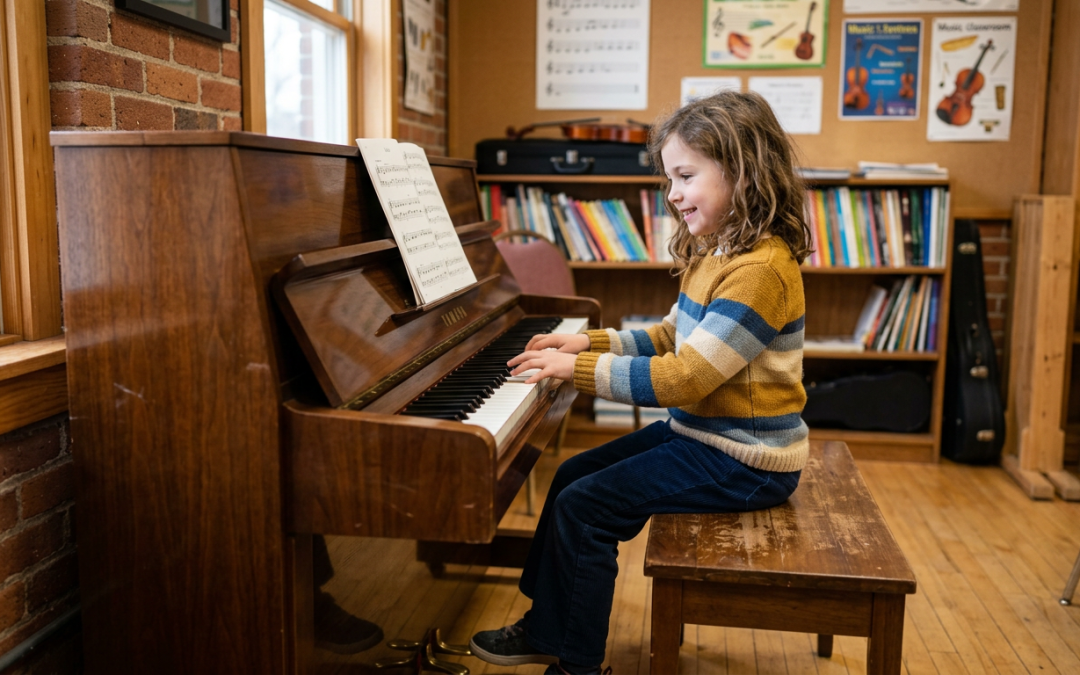
A child is typically ready for private piano lessons between five and seven years old, provided they show basic letter recognition, independent finger movement, and the ability to focus for twenty to thirty minutes. Chronological age matters less than developmental readiness, motor coordination, and curiosity. Assessing these developmental markers helps parents choose the right moment to begin structured instrumental education.
Many families wonder if their young child should begin formal music training right away or wait another year. Starting too early can lead to unnecessary frustration, while waiting too long can miss a prime window of auditory and cognitive development. By looking at specific motor, cognitive, and social milestones, parents can make an informed decision that sets their child up for lifelong musical enjoyment.
What Developmental Milestones Indicate Piano Readiness?
Children need specific fine motor skills, hand size, and physical coordination to press individual piano keys comfortably without strain. A child should be able to move individual fingers independently rather than pressing keys with their whole hand. If your child can hold a pencil with a mature grip, use scissors safely, and tie their shoes, their finger dexterity is generally mature enough for beginner keyboard geography.
Hand size is another practical consideration for early keyboard study. A child does not need large hands, but their fingers must have sufficient strength to press down weighted acoustic piano keys without collapsing their knuckles. Good posture also plays a central role. Students must be able to sit upright on a piano bench with their feet supported on a footstool for the duration of a lesson.
Basic cognitive milestones make early music reading much smoother. Beginner piano method books rely heavily on the musical alphabet, which uses letters A through G. If your child recognizes these letters quickly and understands left-to-right reading order, they will grasp printed musical notation with greater ease. Number recognition from one to five is equally helpful, as standard piano fingering assigns numbers one through five to the thumb through pinky.
How Can Parents Test Fine Motor Control at Home?
Parents can assess finger independence at home through simple, playful finger-tapping games at a kitchen table. Ask your child to place their hand flat on the table and lift only their thumb, then only their index finger, moving across each digit one by one. If they can isolate their fingers without moving their entire arm, their neural pathways for fine motor control are functioning well.
Another useful home check involves basic rhythmic coordination. Tap a steady, simple beat on the table and ask your child to echo the pattern back to you with both hands. A child who can repeat a four-beat rhythm demonstrates the auditory processing and motor timing required for early piano pieces.
Observing how your child interacts with everyday fine motor tasks gives clear clues about hand readiness:
- Can your child manipulate small building blocks or button their coat without assistance?
- Do they show a clear hand dominance while drawing, writing, or eating?
- Can they isolate their pointer finger to trace patterns in sand or on paper?
- Are they able to press a single doorbell or elevator button using a curved finger?
What Attention Span Is Needed for Private Lessons?
Private piano lessons for young beginners usually run for thirty minutes, requiring sustained attention and active listening. A beginner student does not need to sit perfectly still for half an hour, but they must be able to follow multi-step verbal instructions from an adult teacher. If your child participates successfully in a kindergarten classroom or structured sports activity, they can handle the pacing of a private lesson.
Patience with gentle correction is another important social marker. In a private music lesson, instructors regularly adjust hand shape, posture, and rhythm. A child who responds well to friendly guidance and enjoys small challenges will thrive in a one-on-one studio environment.
Emotional maturity also shapes how a young student handles daily home practice routines. Beginner students make frequent mistakes as their hands learn new shapes and patterns. Children who show resilience when a puzzle or drawing does not work out on the first try adapt well to the repetitive nature of instrument practice.
How Do You Choose Between Private Lessons and Group Classes?

Private lessons offer customized pacing and direct technical supervision, making them ideal for focused children ready to learn piano lessons with dedicated attention. Group classes, by comparison, provide a social atmosphere filled with movement and singing, which suits energetic four-year-olds who need broader musical exposure before learning formal keyboard technique.
In a one-on-one setting, the teacher adjusts the lesson plan in real time to match the student’s unique learning speed. If a child grasps note reading quickly but needs extra help with rhythm, the instructor can spend additional time on clapping games and ear training without holding back or rushing classmates.
Choosing the right format depends on your child’s personality and current stage of development:
- Private lessons work best for children who prefer focused attention and want to progress at their own speed.
- Group classes suit younger children who thrive on peer interaction, group singing, and rhythmic movement games.
- Hybrid approaches allow students to gain foundational music appreciation in groups before transitioning to private study.
Families in Baltimore often find that starting with individual instruction gives young learners the strongest foundation in proper hand posture and reading habits. At our school, our instructors assess each student’s temperament to recommend the ideal learning track.
What Should Parents Expect in the First Month of Lessons?
The first month of beginner piano instruction focuses on physical posture, keyboard orientation, high and low sounds, and basic rhythm patterns. Instructors introduce black and white key patterns, helping children find groups of two and three black keys before reading standard staff notation. Lessons at this stage are interactive and exploratory, keeping enthusiasm high while building essential mechanics.
Students also learn the names of finger numbers and practice sitting tall with relaxed shoulders. Teachers use off-bench activities such as clapping rhythms, marching to a steady beat, and drawing musical symbols to reinforce concepts without physical fatigue.
Parents should expect weekly assignments to consist of brief, frequent practice sessions rather than long practice blocks:
- Five to ten minutes of daily practice is plenty for a five- or six-year-old beginner.
- Consistent practice four or five days per week produces far better retention than one long session before the lesson.
- Practice goals in the first month center on finding key patterns and playing simple two-finger or three-finger melodies.
- Parent encouragement and presence during home practice make a tremendous difference in establishing positive routines.
How Does Baltimore Music Education Build Lifelong Confidence?
Structured music education in Baltimore gives children cognitive advantages that extend well beyond the piano bench. Learning to read sheet music develops spatial-temporal reasoning, pattern recognition, and bilateral motor coordination. These foundational skills directly support early math concepts and reading comprehension in elementary school.
Music study also teaches young children the value of steady, incremental effort. When a student works through a challenging musical phrase and masters it after several days of practice, they experience genuine accomplishment. This process builds emotional resilience and self-confidence that benefits academic and personal pursuits for years to come.
Local music communities across Baltimore provide supportive performance opportunities where young students share their progress with friends and family. Experiencing low-pressure student recitals helps children overcome performance anxiety early, turning public presentations into positive, empowering milestones.
Frequently Asked Questions About Starting Piano Lessons
What is the absolute youngest age a child can start piano?
Most music educators recommend waiting until age four or five before beginning formal piano study. Children younger than four generally lack the fine motor control and sustained focus needed for structured keyboard technique, benefiting more from general music and movement classes.
Do we need an acoustic piano at home before starting?
A full-size digital keyboard with eighty-eight weighted, touch-sensitive keys is a practical and effective option for beginner students. While an acoustic piano offers authentic touch and tone, a quality weighted digital piano provides the necessary key resistance for early finger development.
How much should a six-year-old practice each day?
A beginner around six years old should practice for ten to fifteen minutes each day, four to five days a week. Short, focused sessions keep practice engaging and prevent mental and physical fatigue while reinforcing muscle memory.
Can a child learn piano if they cannot read words yet?
Yes, children can begin piano before reading books fluently because early method books use color coding, finger numbers, and simple letter names from A to G. As long as a child recognizes basic shapes and numbers up to five, skilled instructors can guide them effectively.
Conclusion
Evaluating whether your child is ready for private piano lessons comes down to assessing their finger independence, basic alphabet knowledge, and interest in music. Starting lessons when your child exhibits these core developmental markers ensures that their musical education is rewarding and positive from day one. Short, consistent home practice and supportive guidance establish healthy habits that nurture a lifelong love for music.
At The Music Workshop, we provide personalized private music instruction for students of all ages across the Baltimore community. Our experienced teachers guide young beginners through fun, structured lessons tailored to their individual pace and learning style. Visit The Music Workshop today or call our studio at 410-323-1524 to learn more about our lesson programs and schedule your child’s first lesson.